Can the composition be verified?
A vague “surgical” or “hypoallergenic” label is not the same as an applicable ASTM, ISO, or biocompatibility standard.
Jewelry before shopping
Material name is only the beginning. Fit, finish, threading, polish, shape, documentation, anatomy, and healing stage determine whether a piece belongs in the conversation.
Check a placement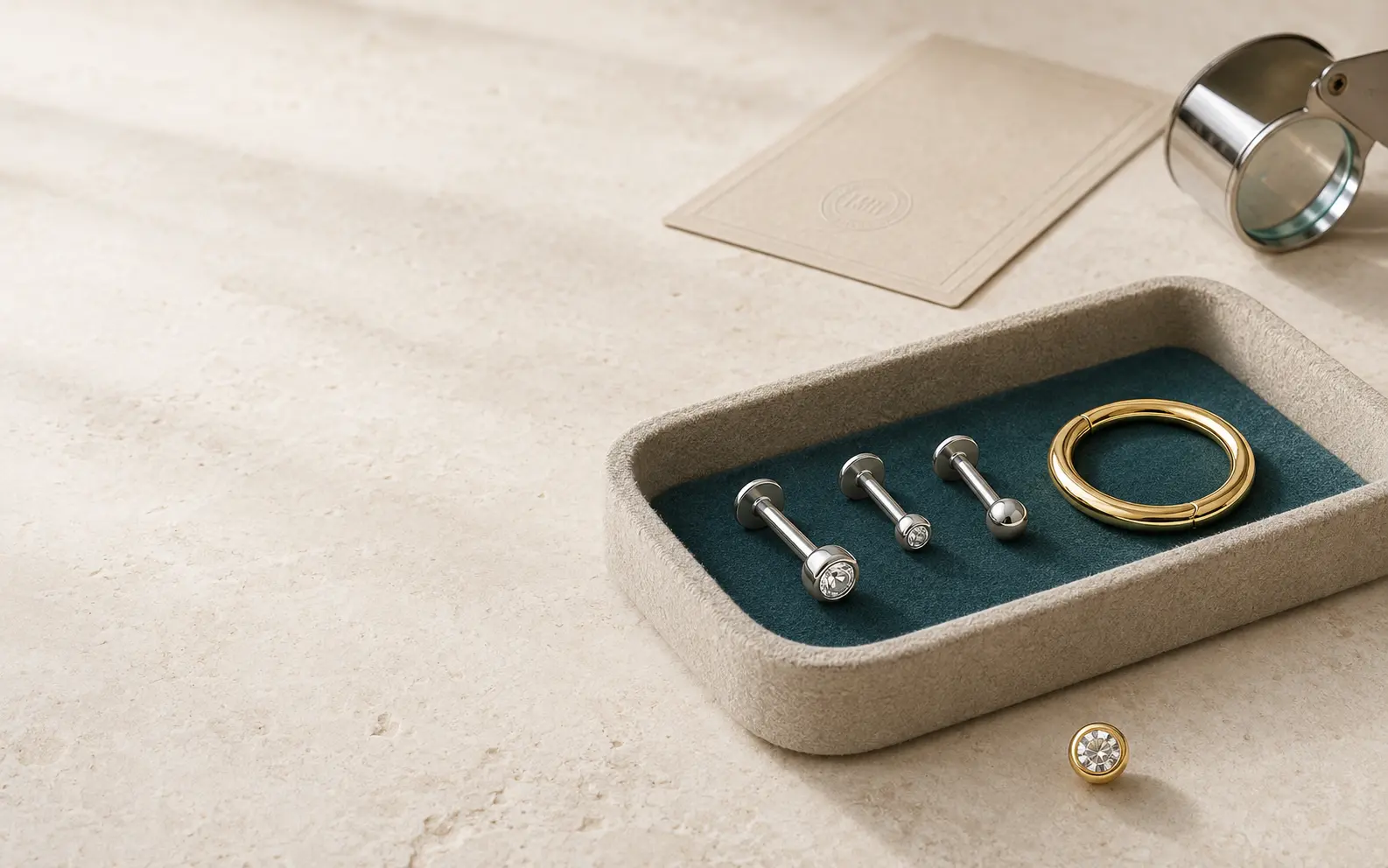
The quality conversation
A vague “surgical” or “hypoallergenic” label is not the same as an applicable ASTM, ISO, or biocompatibility standard.
Initial jewelry needs a high-quality finish without scratches, burrs, polishing compound, or exposed coating.
Threadless and internally threaded systems keep the wearable post smooth. Exposed external threading is a different experience.
Gauge, diameter, wearable length, rise, shape, weight, and room for swelling require professional fitting.
A decorative piece appropriate for a fully healed piercing may be wrong for a fresh or still-fragile channel.
Mill certificates, manufacturer documentation, verification programs, and exact dimensions matter more than marketing language.
Jewelry readiness check
Outer ear cartilage
Cartilage shape, angle, initial jewelry, and later ring plans.
Gauge, wearable length, diameter, shape, threading, finish, and material documentation still matter.
No product is ranked or sold in this private version. Future affiliate collections will appear only after merchant and product specifications pass the published quality rubric.
Material language
Material names alone do not prove biocompatibility. A manufacturer or piercer should be able to explain the applicable specification and documentation.
APP guidance identifies documented ASTM F136, ASTM F1295, ISO 5832-3, or commercially pure ASTM F67 titanium among appropriate initial-jewelry options.
Only specific documented grades are suitable. “Stainless” and “surgical steel” alone do not identify one.
APP guidance describes conditions for karat, alloy, biocompatibility, and finish. Plated, filled, and vermeil jewelry are different products.
These have material- and placement-specific considerations that belong with a qualified professional and verifiable manufacturer information.
How closures work
Mechanism changes what moves through tissue and whether home removal is realistic. Do not change initial jewelry without professional guidance.
A removable end uses a tension-fit pin. The wearable post has no screw threads.
The removable end screws into a smooth post, keeping threads off the wearable surface.
A hinged segment opens and clicks shut. Diameter and seam quality still need to suit the placement.
Ring tension holds a bead or segment. Tools and professional help may be appropriate.
Stage 1 of 3
A removable end uses a tension-fit pin inside a smooth post.
Bend, fit, and removal should be demonstrated by a piercer. Stop if there is resistance, swelling, pain, or uncertain sizing.
Educational schematic only. It does not show a self-change technique, and it is never a reason to remove initial jewelry prematurely.
Affiliate-ready, not affiliate-led
Piercings.how will reject merchants or products that cannot support exact material, dimension, finish, threading, photography, availability, return, and sizing claims. Commission cannot override that decision.
No products, prices, discounts, or affiliate links are live in this private version.
Confirm current program availability, acceptance, geography, inventory feeds, disclosures, and product-level evidence directly with each candidate.
Only after professional sizing education, with clear affiliate disclosures and graceful out-of-stock handling.