Pressure
Which ear do you sleep on and what presses against it?
Lobe to cartilage
Ear projects can look small while asking for major changes to sleep, headphones, hair care, helmets, phones, and the sequence of a future curation.
General education reviewed July 15, 2026. Anatomy approval requires an in-person specialist.
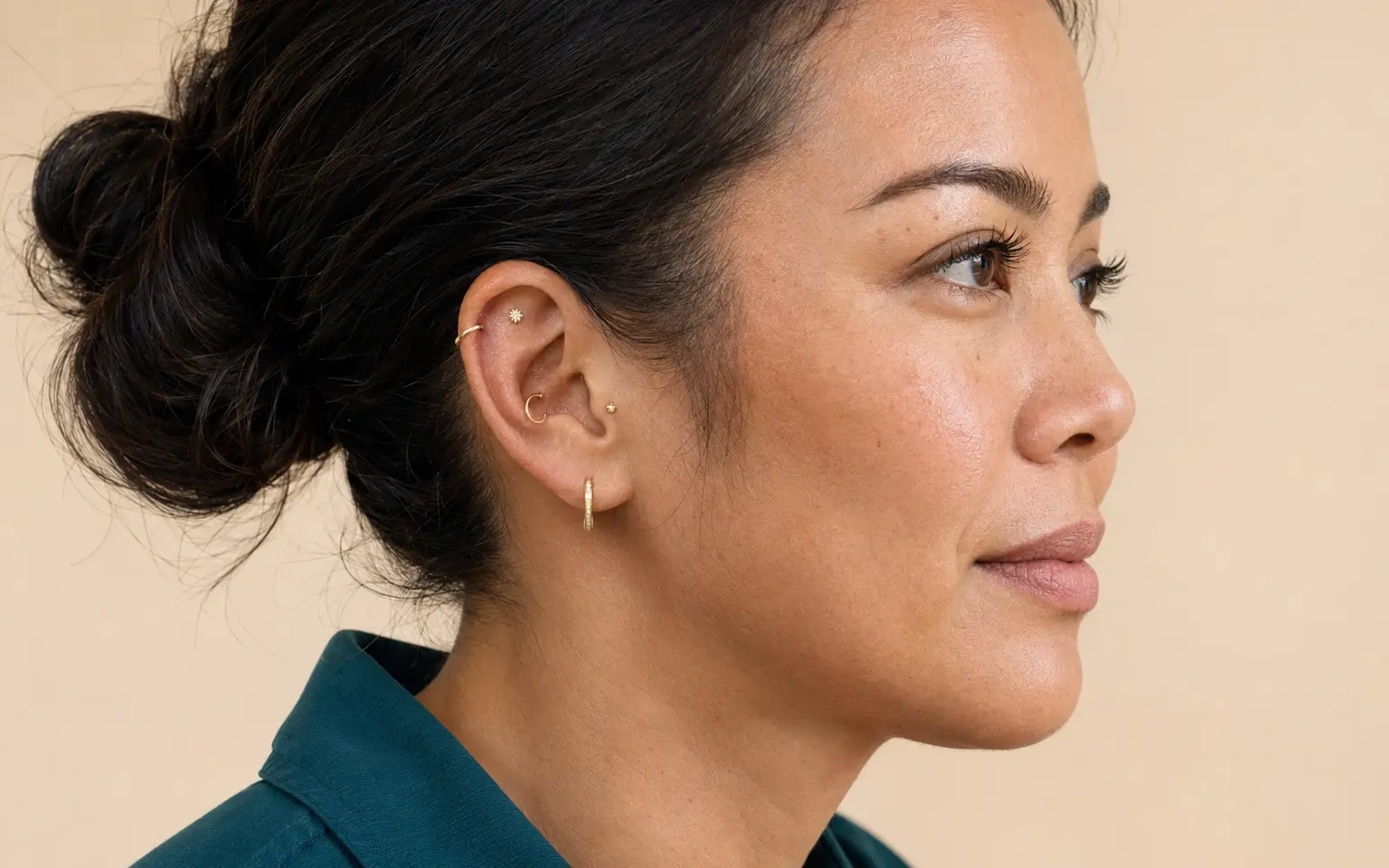
Before choosing
Your piercer may raise other considerations after seeing your anatomy and hearing your goals.
Which ear do you sleep on and what presses against it?
Do earbuds, glasses, helmets, headphones, or a stethoscope crowd the area?
Are you choosing one placement or building an ear over time?
Placement-by-placement
Soft lower-ear tissue
Usually one of the shorter piercing-healing commitments, but still not instant.
Pillow, phone, headphones, hair, and future spacing all matter.
Flat-back labret or another professionally selected initial style.
Pressure, snagging, embedding, and closure after removal.
Tissue space, placement balance, initial fit, and future styling.
Upper soft tissue near the cartilage border
Healing can behave differently when the placement sits close to cartilage.
Check glasses, over-ear headphones, hair, and stacked-lobe spacing.
Flat-back labret is commonly discussed.
Pressure, angle changes, crowding, and uneven spacing.
Whether the chosen point is lobe tissue, cartilage, or a transition area.
Outer ear cartilage
A months-long cartilage commitment that is sensitive to repeated pressure.
Side sleeping, helmets, hair, towels, and headphones can prolong irritation.
Flat-back labret is often used initially; rings may be considered later.
Angle shifts, irritation, scarring, and prolonged healing.
Cartilage shape, angle, initial jewelry, and later ring plans.
Front rim of upper-ear cartilage
Cartilage healing with limited room and frequent hair or glasses contact.
Glasses arms, hair, hats, and sleep position deserve a test fit.
Small flat-back labret selected for anatomy.
Crowding, snagging, embedding, and angle shifts.
Available tissue, jewelry clearance, and whether a single or curated group fits.
Flat upper-ear cartilage
Longer cartilage healing with direct pillow and helmet pressure concerns.
Helmets, over-ear headphones, hair, and sleep pressure can cross this area.
Flat-back labret with a low-profile end.
Pressure, swelling, snagging, and angle changes.
Flat-space size, angle, decorative-end clearance, and future curation.
Cartilage projection beside the ear canal
Cartilage healing that benefits from low pressure and careful follow-up.
Earbuds, stethoscopes, phones, and in-ear protection can conflict.
Flat-back labret is commonly discussed.
Irritation, embedding, angle shifts, and ongoing earbud conflict.
Tissue size, angle, initial jewelry, and earbud clearance.
Cartilage opposite the tragus above the lobe
An anatomy-dependent cartilage placement with pressure exposure.
Earbuds, pillows, phones, and nearby jewelry may crowd the site.
Curved barbell or other anatomy-specific initial style.
Pressure, migration, rejection, and prolonged irritation.
Projection, tissue thickness, angle, and jewelry clearance.
Central bowl of ear cartilage
A months-long cartilage commitment.
Earbuds and direct sleep pressure may determine whether the placement works now.
Flat-back labret initially; a ring may be an after-healing option.
Pressure, angle shifts, snagging, and prolonged swelling.
Inner-ear anatomy, placement angle, stud-to-ring goals, and fit.
Inner cartilage fold above the ear canal
An anatomy-dependent cartilage healing journey.
Earbuds, hearing devices, and cleaning access can be limited.
A professionally fitted ring is commonly considered.
Migration, pressure, cleaning difficulty, and false migraine-treatment claims.
Whether the fold is suitable and which ring style can be safely fitted.
Upper inner cartilage ridge
Cartilage healing in a protected but anatomy-dependent fold.
Headphones, glasses, hair, and sleep can still add pressure.
Curved barbell selected for the ridge.
Migration, rejection, swelling, and prolonged irritation.
Ridge definition, depth, angle, and jewelry room.
Inner antihelix cartilage ridge
Often considered a demanding cartilage heal because of pressure and anatomy.
Pillows, headphones, and naturally tight ear contours matter.
Curved barbell selected by the piercer.
Swelling, migration, rejection, and long-term irritation.
Whether the ridge is pronounced enough and whether an alternative gives a similar look.
Two cartilage piercings connected by one bar
Two healing sites whose angles must remain aligned.
Sleep, headphones, helmets, hair, and glasses can put force on the shared bar.
One fitted straight barbell through two compatible sites.
Pressure damage, angle shifts, scarring, and anatomy incompatibility.
Whether both points align without the bar pressing on the ear.
Two piercings connected by one ring
Two sites must heal in a relationship that preserves the ring path.
Pressure and movement affect both openings at once.
One ring connecting two professionally aligned sites.
Angle mismatch, pressure, migration, and difficult healing.
Exact anatomy, spacing, angle, and whether staged healing is preferable.
Healing and follow-up
These shared guardrails do not replace the placement-specific risks above or the written instructions from the professional who performed the piercing.
Localized tenderness, swelling, bruising, and a small amount of pale fluid that dries into crust may occur early. The pattern, severity, and direction of change matter more than a single snapshot.
Ask promptly about jewelry that feels too tight or unstable, repeated snagging, pressure, a changing angle, possible migration, or the timing of a professional downsize.
Increasing heat, swelling, pain, pus, fever, chills, or feeling unwell warrant medical advice. Breathing or swallowing difficulty requires urgent medical care.
Do not remove initial jewelry prematurely. A professional should confirm healing, gauge, wearable length, diameter, material, mechanism, and whether a new style suits the placement.
SourceAPP aftercare guidance ↗
SourceNHS infection guidance ↗
Procedure expectation
A responsible appointment includes consultation, anatomy assessment, jewelry selection, setup, marking, renewed consent, the piercing and jewelry transfer, written aftercare, and a follow-up plan. Piercings.how does not teach technique.
See the appointment sequence →Pain without a score
Stress, anatomy, placement, professional technique, tissue type, and prior experience all affect sensation. A universal one-to-ten score looks useful but cannot predict your experience.
Retirement
A retired piercing may shrink or close quickly and usually leaves some permanent change or scar. Ask a piercer about removal and a clinician when infection is suspected.
Sources and limits